
Do’s & Don’ts Of Newly Paved Asphalt Pavement
Learn what to do, what to avoid, and why it matters if you have recently had a driveway or parking lot paved in Rochester, NY or the surrounding areas.
Tandoi Asphalt & Sealcoating recommends the following guidelines to help protect your investment and extend the life of your asphalt surface.
Do’s & Don’ts
Don’t drive on your driveway for at least five days
Longer wait times may be required during hot weather, as asphalt takes more time to fully set and stabilize.
Do’s & Don’ts
This is the heading
Longer wait times may be required during hot weather, as asphalt takes more time to fully set and stabilize.
Don’t place sharp or pointed objects on your driveway.
Longer wait times may be required during hot weather, as asphalt takes more time to fully set and stabilize.
Reason:
When weight is concentrated in a small area, it can press into the asphalt surface and leave permanent marks.
Don’t drive near the edges of your driveway.
Driving too close to the edges can cause cracking and structural damage.
Reason:
Asphalt is supported by a gravel or stone base. If weight is placed on unsupported edges, the pavement can crack.
How to prevent it:
Driveways are installed slightly above grade to allow for proper drainage. If edges are not supported, water can erode the surrounding soil. Adding soil or sod along the edges helps reinforce and protect the structure.
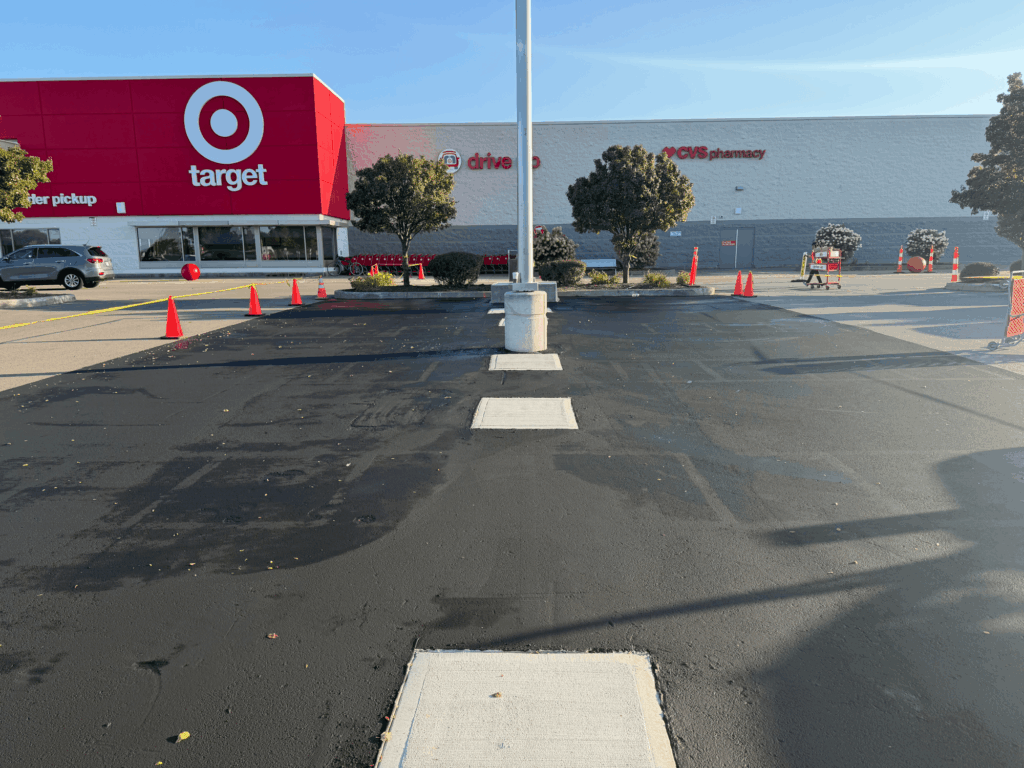

During the curing period, avoid parking in the same spot repeatedly. Changing parking positions helps prevent depressions from forming.
More Do’s & Don’ts
Don’t turn your wheels sharply while the vehicle is not moving.
This can cause surface scarring, also known as power steering marks.
Reason:
New asphalt remains softer during the curing process. Friction from stationary turning can damage the surface, especially during warmer temperatures.
Don’t be alarmed by small puddles.
Minor puddling can occur due to natural settling in the base layer.
Reason:
New asphalt contains oils that temporarily affect water drainage. As the pavement cures, these oils dissipate and drainage often improves.
Don’t allow weeds or vegetation to grow along the edges.
Small surface bumps may indicate early weed growth.
How to prevent it:
Applying weed control or using a simple salt and water solution can help eliminate growth along the edges.
Don’t accelerate too quickly or brake aggressively.
Sudden movement can cause scarring or surface wear.
What You Should Do
Do drive over your driveway after initial excavation.
This helps compact the base and create a stronger foundation. The surface should sit for at least 4 weeks before final paving whenever possible.
Do place soil along the edges of your driveway.
This helps support the edges and reduces the risk of cracking over time.
Do sealcoat your driveway.
Sealcoating helps extend the life of your asphalt and protect it from weather and wear. It is typically recommended between 90 days to 1 year after paving.
Do apply weed control along the edges.
This helps prevent vegetation from growing through or around the asphalt surface.
Do sweep your driveway at least once per year.
Removing debris helps prevent surface damage and allows you to identify cracks or wear early.
Addressing minor issues early can help avoid more costly repairs in the future.
Contact Tandoi Asphalt
If you have questions about maintaining your asphalt or need professional paving, sealcoating, or repair services, the team at Tandoi Asphalt & Sealcoating is here to help.
Contact us today to request a free estimate.